
Controlled Autonomy
The Architectural Doctrine for Agentic Enterprise Systems
Enterprise governance faces structural failure under the pressure
of agentic deployment. Organizations are inserting probabilistic
systems into deterministic architecture 4 and producing the
structural failure that follows. This paper defines the
architectural doctrine for resolving that failure at the deployment
substrate.

The Structural Failure
Enterprises are inserting probabilistic systems into deterministic infrastructure.
Governance models built for static automation cannot supervise adaptive systems.
Constraint suppresses capability.
Unbounded autonomy produces systemic exposure.
This is not a tooling problem.
It is an architectural mismatch at the deployment substrate.
The result is predictable:
- Over-constraint and suppressed intelligence
- Shadow systems and unsanctioned AI usage
- Tool sprawl and fragmented oversight
- Uncontrolled compliance exposure
The governance paradox is structural — and it cannot be resolved through policy alone.
The Architectural Doctrine
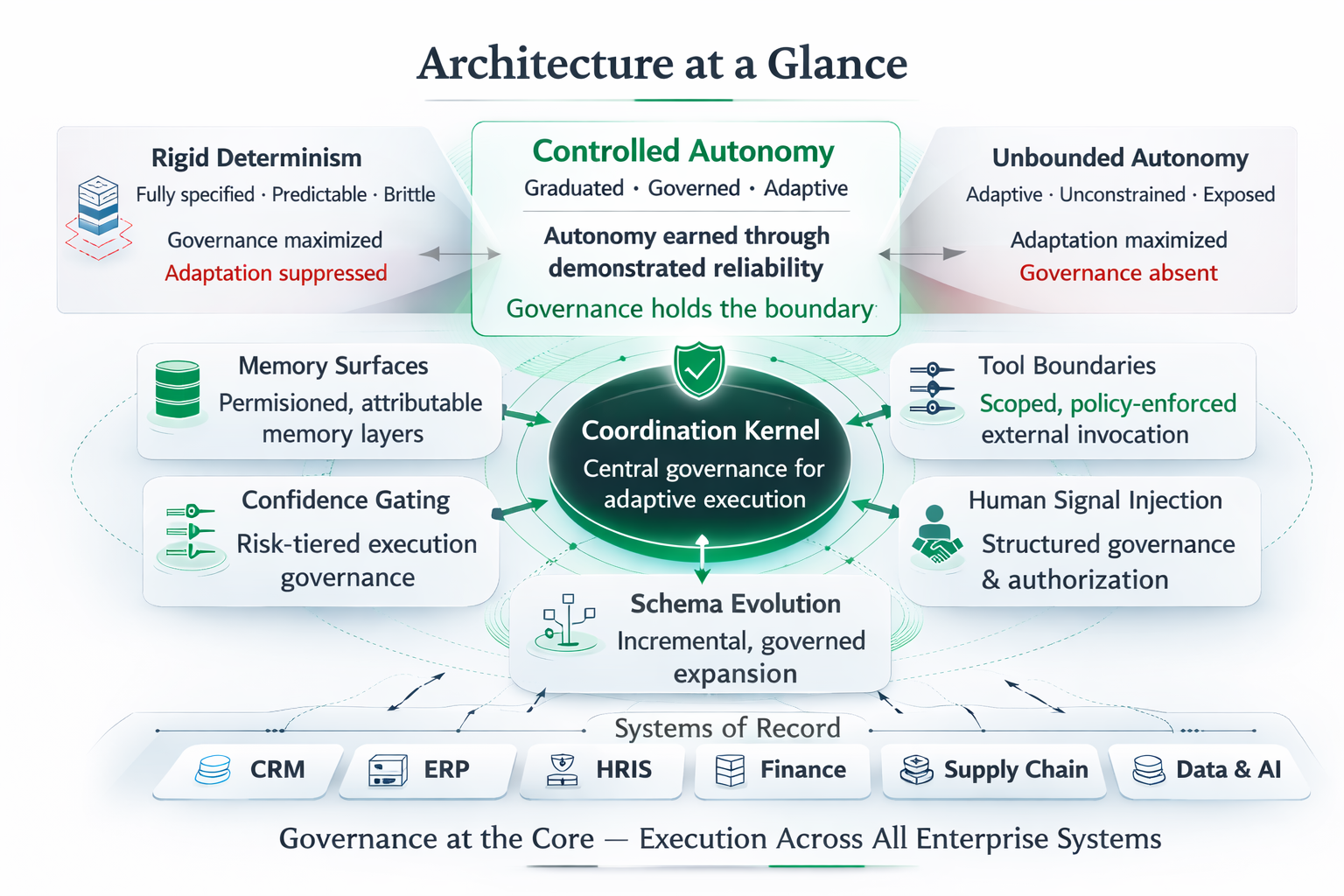
Controlled Autonomy defines a third path between rigid determinism and unbounded autonomy.
It introduces a coordination infrastructure composed of five primitives:
- Permissioned memory surfaces
- Bounded tool invocation
- Confidence-tiered execution gating
- Structured human signal injection
- Governed schema evolution
These primitives operate through a coordination kernel — an execution-layer governance mechanism that enforces entitlements, routes actions across systems of record, and produces auditable trails across enterprise surfaces.
Governance does not sit above execution.
It operates within it.
Autonomy expands through demonstrated reliability — and remains revocable through structural control.


From Experiment to Infrastructure
AI deployment is no longer experimental. It is architectural.
Controlled Autonomy transforms agentic capability from isolated intelligence into governed execution.
Under this doctrine:
- Shadow systems contract
- Scalability compounds without proportional risk
- Auditability becomes structural rather than retrofitted
- Governance becomes the mechanism by which capability expands
CRM is the first application surface — not the last.
Enterprises that adopt this doctrine will not merely integrate AI.
They will institutionalize it.
Let’s orchestrate your next breakthrough.
Meet with Provenonce to identify the gaps between tools, data, and cognition within your existing systems — and discover how coordination can become your new compute layer.